

By Attiyya Atkins
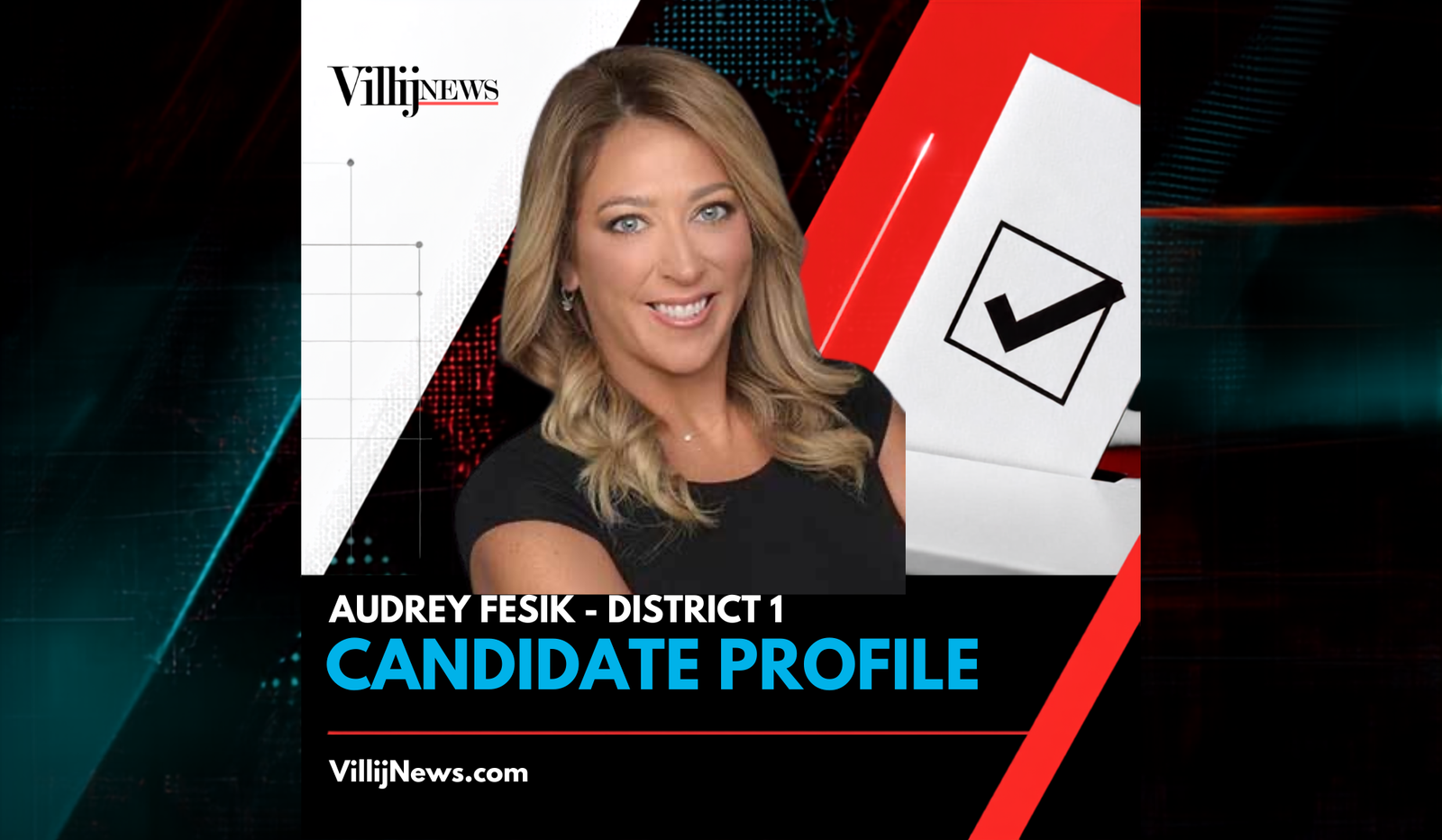
Pompano Beach District 1 Commissioner Audrey Fesik is making infrastructure, flooding and fiscal restraint central to her case for another term, while calling for greater scrutiny of major City projects, Airpark growth and how residents participate in local government.
POMPANO BEACH, Fla. — Commissioner Audrey Fesik says some of the most important work happening in Pompano Beach isn’t flashy.
Sometimes, it’s simply getting a neighborhood street paved.
For Fesik, that distinction — between what residents need and what government may want — runs through much of her argument for another term representing District 1.
She points to neighborhood infrastructure, particularly work in Harbor Village, as one of the most tangible results of her time on the Commission.
“When I took office, I learned that we had fallen behind on our five-year paving plan,” Fesik told Villij News. “That was unacceptable to me.”
Fesik said she supported putting additional money into neighborhood paving during the 2026 budget process and continued supporting the work in the 2027 budget.
She also supported traffic-calming measures in response to complaints about speeding and cut-through traffic. But Fesik acknowledges that some of those changes — particularly speed humps — have drawn mixed reactions.
“I’ve heard that feedback too, including from residents on Harbor Drive,” she said.
Fesik says she is now pushing for more standardized traffic-calming options and a better process before additional installations are approved.
But paving has encountered another challenge.
Fesik said the City recently learned that approximately $1.4 million in anticipated Broward surtax funding would not be available. She says she is working to identify replacement funding so a budget amendment can be considered in October and remaining streets can stay on track.
“The goal is simple: finish the paving plan we committed to residents,” Fesik said.
“That may not be the flashiest accomplishment, but residents absolutely know when their street finally gets paved.”
Her larger argument is equally straightforward.
“I believe basic infrastructure should come before expensive wish-list projects.”
Flooding remains unfinished business
Asked what she wanted to accomplish during her term but has not yet finished, Fesik pointed to flooding and aging infrastructure on the barrier island.
She says progress has been made on both South and North Riverside, but the work is not complete.
Fesik recently supported funding to begin a stormwater and utility project on South Riverside aimed at addressing longstanding flooding.
North Riverside has presented a more complicated challenge.
Because of its location and potential environmental impacts, Fesik said the project requires coordination and approvals involving multiple local, state and federal agencies.
She says the City has made substantial progress through that process, but funding is now a major hurdle after anticipated grant funding did not materialize.
“My answer isn’t that we didn’t get the grant, so residents have to keep waiting,” Fesik said. “No matter what, we’re going to have to work together to solve these problems.”
For Fesik, infrastructure is one of local government’s most basic obligations — even when much of that work happens underground and receives little public attention.
“Roads, drainage, stormwater, water and sewer are fundamental responsibilities of local government,” she said.
That belief shapes how she says the City should approach other spending.
“We may have to make difficult budget choices, but I’d rather make those choices than continue asking residents who have already waited years to wait again.”
Her summary:
“Fix what we have. Fund what we need. Then talk about what we want.”
Are City Hall’s priorities matching residents’ priorities?
Fesik says residents are increasingly asking her a fundamental question about Pompano Beach government:
Are the City’s priorities matching theirs?
She says conversations with residents frequently center on traffic, flooding, aging infrastructure, development, taxes and the amount of public money being committed to major projects.
Increasingly, she said, those conversations include the New Downtown and proposed New City Hall.
Fesik did not serve on the Commission when the Downtown Master Development Agreement was approved in June 2024. She says she inherited an agreement that created significant obligations for the City and CRA, including moving forward with a new City Hall as part of the Downtown redevelopment.
“What concerns me is how little flexibility that agreement left future commissions,” Fesik said.
She says her questions since taking office have centered not only on whether the Downtown should be revitalized, but on the terms under which taxpayers participate.
“These agreements didn’t write or negotiate themselves,” Fesik said.
She wants greater scrutiny of the advice City officials received, the risks identified during negotiations, the protections and potential exit strategies that were considered and why future commissions were left with what she describes as limited practical options.
Fesik said that does not mean she opposes Downtown revitalization or private investment.
“The question is what the public is obligated to provide, what the private developer is obligated to provide, how much taxpayers ultimately pay, and whether those obligations leave us enough flexibility to address the City’s fundamental needs,” she said.
She applies the same reasoning to the McNab Park project and other large discretionary expenditures.
Before committing additional public dollars or future revenue, Fesik says residents should understand not only what a project costs but what spending on that project could prevent the City from funding elsewhere.
“The question shouldn’t just be, ‘Can we afford this project?’” Fesik said. “It should also be, ‘What aren’t we funding because we chose to spend the money here?’”
Airpark growth puts development, neighborhoods and environment in focus
Asked where her priorities are most visible in her budget decisions and voting record, Fesik pointed to investments she has supported in public safety, paving, stormwater and infrastructure.
She also pointed to projects she has questioned.
One of the clearest examples, she said, is the Pompano Beach Airpark.
For Fesik, the debate is bigger than aviation.
She says it encompasses development, environmental protection, aircraft activity, noise, safety and quality of life for neighborhoods surrounding the Airpark.
Fesik said residents have raised concerns about flight-training activity and aircraft traveling over their neighborhoods. She supports pursuing an FAA Part 150 Noise Study and additional studies that could provide objective information about current and future Airpark operations.
“If the Airpark continues to grow, I want that growth evaluated against reasonable limits and with meaningful consideration of the people who live around it,” she said.
Fesik also raised concerns about recent land-use changes at the Airpark.
She said 46.4 acres previously classified as Open Space Recreation on the City’s land-use map and Parks and Recreation on the County’s map were changed to Transportation, while environmentally sensitive land designations were removed from additional Airpark property.
Fesik points to objections from Broward County’s Parks and Recreation Division as evidence that the environmental questions extend beyond neighborhood opposition.
She said the County’s review warned about the potential loss of natural areas containing scrub habitat.
“These aren’t simply empty parcels waiting for another use,” Fesik said. “They are part of what remains of South Florida’s natural environment.”
Fesik has also questioned whether the City’s environmental review should be supplemented by another independent assessment.
She expressed concern that a consultant involved with the Natural Resource Assessment was also involved with the Airpark Master Plan and work associated with future development.
“When the same consultant is involved with planning future development and evaluating environmental resources that could potentially constrain that development, I think it’s reasonable to ask whether we should obtain a truly independent environmental assessment,” Fesik said.
Fesik stresses that she is not opposed to the Airpark itself.
“It’s an important City asset, and aviation has legitimate operational and safety requirements,” she said. “But being supportive of an asset doesn’t mean approving unlimited growth without understanding its consequences.”
She describes her preferred approach as balance: protect the Airpark, nearby neighborhoods, public safety and remaining natural resources.
“Some decisions can be changed by a future Commission,” Fesik said. “Once the last pieces of natural Florida are gone, we don’t get to vote them back.”
Reaching the residents who aren’t at City Hall
When asked who she needs to hear from more, Fesik did not identify one neighborhood.
She pointed instead to residents who rarely participate in traditional City Hall meetings.
“The people I need to hear from more are often the people we don’t see at City Hall,” Fesik said.
She noted that working parents, business owners and other residents may not have hours available to sit through Commission meetings.
Fesik says she has tried to compensate by making her cell phone number available, responding on social media and meeting residents in neighborhoods and businesses.
“I’m a commissioner, but I’m a neighbor first,” she said. “Residents shouldn’t have to navigate City Hall before they can reach me.”
But Fesik says accessibility should extend beyond an individual commissioner’s availability.
She wants Pompano to explore meaningful virtual participation in public meetings, including allowing residents to speak remotely.
She also wants the City to reconsider meeting times based on resident feedback.
“If our goal is public participation, then we should be asking whether the way we schedule and conduct meetings actually makes participation easier,” Fesik said.
Fesik wants regular Commission workshops
Fesik also wants Pompano to make regular Commission workshops a larger part of how major policy decisions are developed.
Her argument is that commissioners, staff and residents should have opportunities to discuss major proposals before they reach the dais for final action.
“Too often, by the time residents see a major item on an agenda, an enormous amount of work has already occurred behind the scenes and the options may already be significantly narrowed,” Fesik said.
She argues earlier discussions could allow questions and alternatives to emerge before the City has invested substantial time and resources in a particular direction.
“That isn’t about making government slower,” she said. “I think doing more work collaboratively on the front end can actually make government more effective and prevent costly problems later.”
Should Pompano rethink its six-member Commission?
Fesik is also raising a more fundamental question: whether Pompano Beach’s current governing structure should change.
The City currently has five district commissioners and an at-large mayor, creating a six-member voting body.
That means a divided Commission can deadlock 3–3.
Fesik says alternatives deserve public discussion.
One possibility she raised would retain an at-large mayor but have the mayor vote only when necessary to break a tie.
Another would eliminate the separately elected at-large mayor and have the five district-elected commissioners select a mayor and vice mayor from among themselves.
Pompano operates under a commission-manager form of government, meaning the City Manager — rather than the mayor — oversees day-to-day City operations.
Fesik says that makes it fair to examine whether another structure could strengthen district representation and eliminate recurring tie votes.
But she emphasized that such a change should not be made simply because one commissioner supports it.
“They deserve public discussion, legal review and, where required, a decision by the voters,” Fesik said.
“Fix what we have”
Across Fesik’s answers, one theme repeatedly surfaces: basic City responsibilities should come before discretionary ambitions.
She points to neighborhood paving as evidence of progress and barrier-island flooding as unfinished work.
She questions whether Downtown and City Hall obligations leave enough flexibility for other priorities.
She wants greater scrutiny of Airpark expansion and its potential impact on surrounding neighborhoods and environmentally sensitive land.
And she argues that residents should have more opportunities to influence major decisions before the City’s options have narrowed.
For Fesik, infrastructure, spending and public participation are not separate issues. They are questions about what local government should prioritize — and whose priorities ultimately shape those decisions.
“Fix what we have. Fund what we need. Then talk about what we want,” Fesik said.
And when it comes to how she sees her own role, she returns to an equally simple message:
“I’m a neighbor first, and I will always be an ally for the residents I serve.”
Discover more from Villij News
Subscribe to get the latest posts sent to your email.