


By Attiyya Atkins

POMPANO BEACH — Pompano Beach is growing. The question facing voters this November may be what kind of growth they want — and who gets to benefit from it.
Candidates seeking seats on the Pompano Beach City Commission laid out competing visions for the city during a Greater Pompano Beach Chamber of Commerce candidate forum, with redevelopment, housing affordability, infrastructure, neighborhood representation and the role of City Hall emerging as central themes.
Across the stage, there was broad agreement that development will continue in Pompano Beach. The disagreements were over how aggressively the city should encourage it, whether existing residents are sufficiently involved in development decisions and whether the benefits of Pompano’s transformation are reaching neighborhoods throughout the city.
Again and again, candidates returned to one phrase: residents need a “seat at the table.”
But what that means differed depending on who was speaking.
Pompano Beach voters will elect commissioners for Districts 1 through 5 on Nov. 3. Under the city’s current charter, district commissioners are elected to two-year terms.
District 1: Fesik and Worley Differ on City’s Role in Growth
District 1 Commissioner Audrey Fesik, who is seeking reelection, presented herself as a resident-focused check on development and city spending.
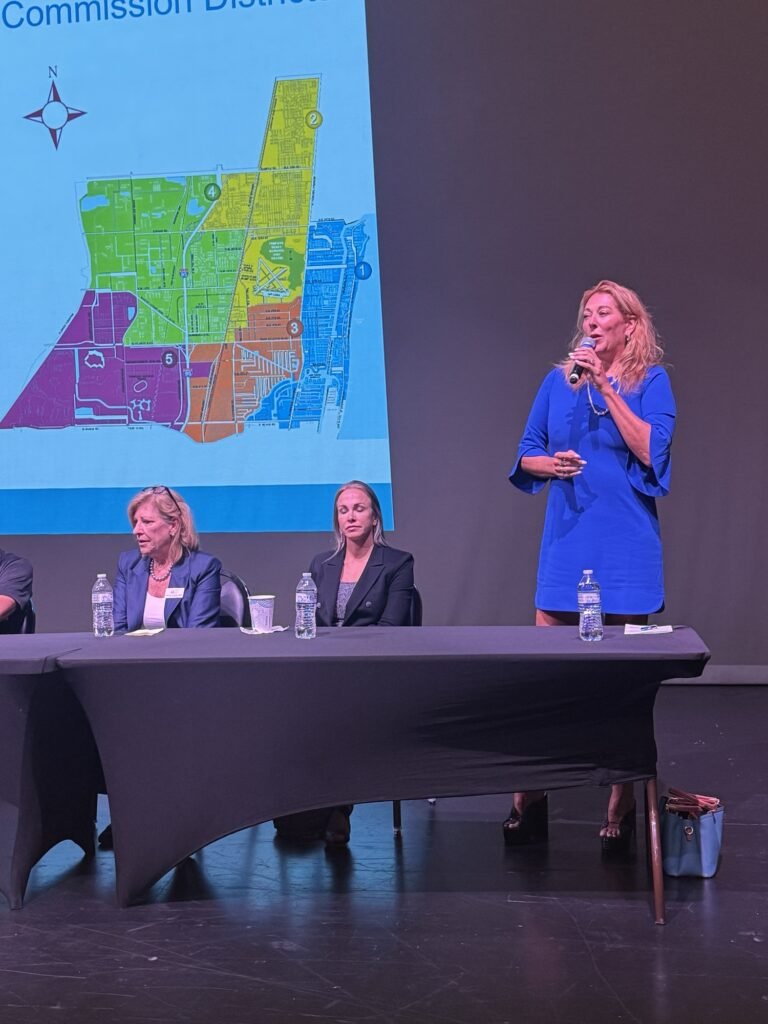
Fesik said she supports development but believes the commission’s responsibility is not simply to facilitate it.
“The city’s job is to encourage but not promote economic development,” Fesik said. “The city’s job, as far as this board is concerned, as we’re sitting as commissioners, is to represent the residents of the city — to be the checks and balances of economic growth.”
Fesik said she supports “good, responsible development,” but raised concerns about infrastructure keeping pace, particularly in the beach area.
“I am very concerned, especially in the beach area where we have had rampant development, and yet our roads are still not paved,” she said.
Her comments reflected a broader platform emphasizing resident input, scrutiny of public spending and ensuring developers’ interests do not outweigh those of existing neighborhoods.
Fesik also addressed the difficulty of retaining workers who cannot afford to live in Pompano Beach. She said a conversation with the city’s utilities director highlighted the possibility of losing qualified employees because of housing costs.
“What we have to do is really work together to make sure that we are creating opportunities for workforce housing,” Fesik said.
She suggested there could be opportunities involving available land and partnerships in the Northwest CRA, while also emphasizing controlling government costs.
Fesik’s challenger, Keriann Worley, offered a more explicitly pro-growth message while also emphasizing infrastructure, public safety and adherence to the city’s development rules.
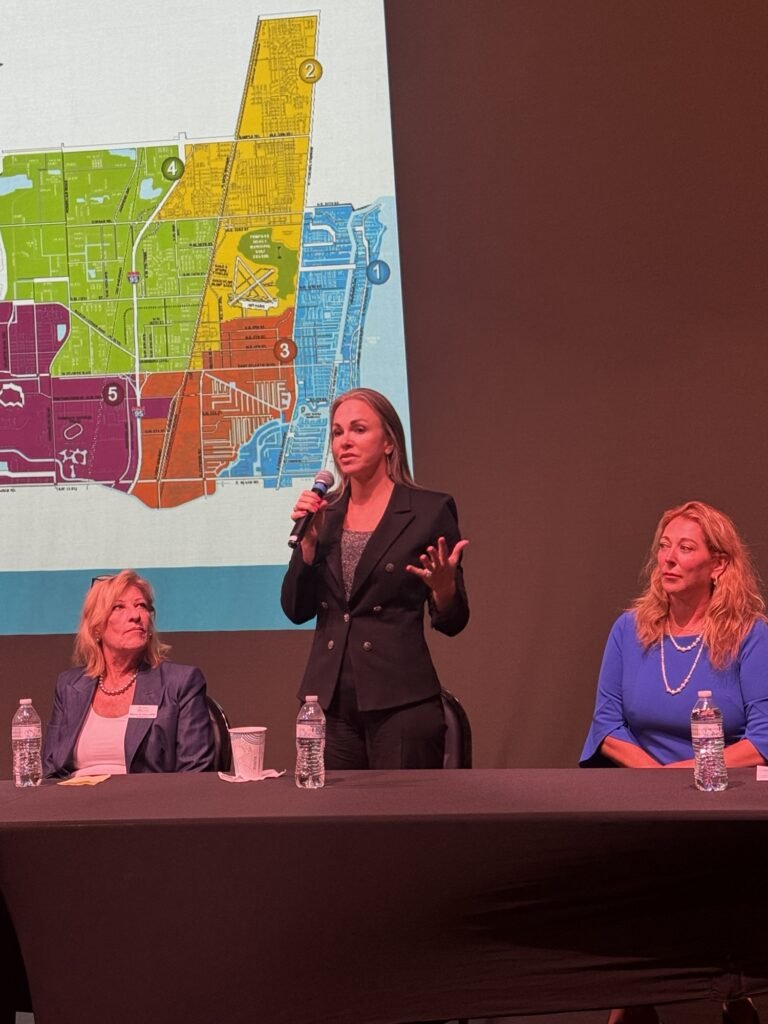
Worley, a Pompano Beach resident since 2002, told attendees she raised her three children in the city and has served on several community boards, including the Chamber board. She also pointed to her professional experience as a human resources director and market president for a South Florida broadcasting company.
Worley contrasted today’s Pompano with the city she encountered more than two decades ago.
“When I moved here in 2002, there was really nothing going on in Pompano,” Worley said, pointing to the restaurants and businesses that have arrived as the city has redeveloped.
She described herself as “pro-growth,” but said development must remain consistent with the city’s plans and codes.
“We need to work with the developers or the builders and make sure that that stays within code,” Worley said. “We have a plan for the city. We need to stay within code, and we need to make sure that the residents feel very comfortable and have a seat at the table before things are happening.”
Worley also placed public safety and infrastructure alongside development as economic issues.
“Safety is our number one priority,” she said. “If we don’t have a safe environment, then your businesses are going to be closed. There’s nobody on the sidewalks.”
Her remarks at the forum emphasized managed growth, public safety, infrastructure investment and cooperation among different levels of government and the development community.
District 2: Three Different Visions for Growth
The District 2 discussion produced some of the forum’s clearest disagreements over development.
Incumbent Commissioner Rhonda Sigerson-Eaton defended the city’s redevelopment record and argued that long-term planning has helped transform Pompano Beach while expanding its tax base.
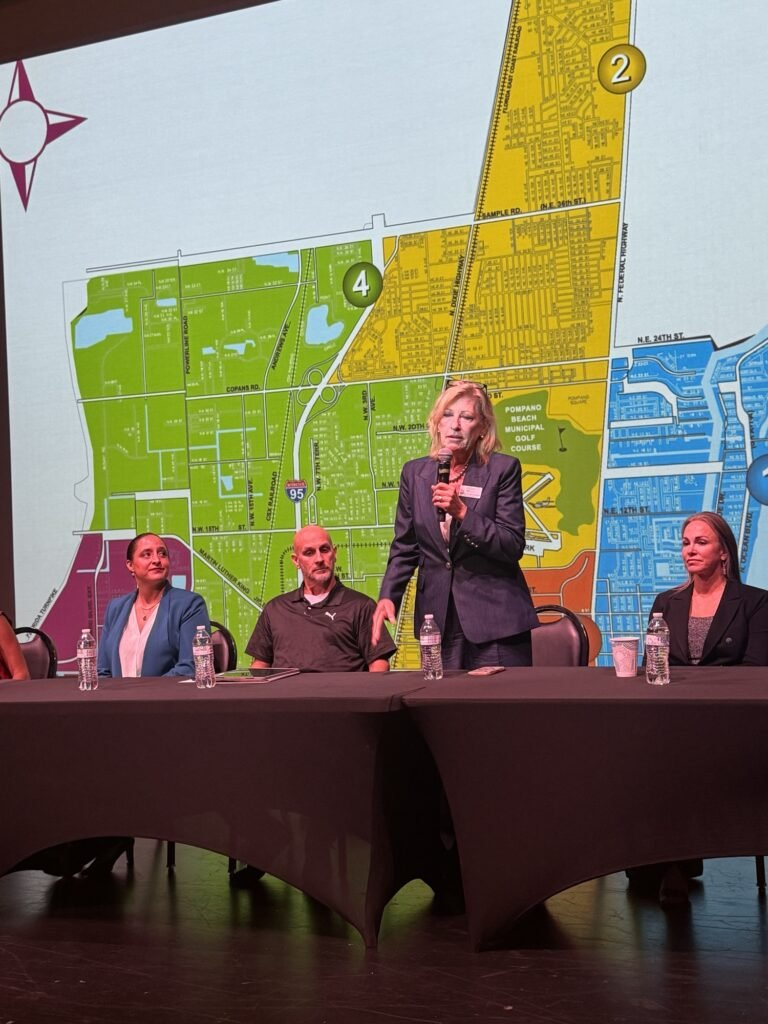
“We have experienced a lot of growth over these past 10 years,” Sigerson-Eaton said, pointing to the Fishing Village and East CRA.
She said Pompano has become increasingly visible as a tourism destination and described future downtown redevelopment as another long-term opportunity.
“We had a vision, but more than that, we had a plan,” she said of previous redevelopment efforts.
Sigerson-Eaton argued that future development should expand the city’s tax base without adversely affecting existing residents. Her approach emphasized long-term planning and using new development to generate additional property value and revenue.
Her challenger Freddie York, a Pompano business owner, questioned whether city-supported development is contributing to rising costs for existing residents.
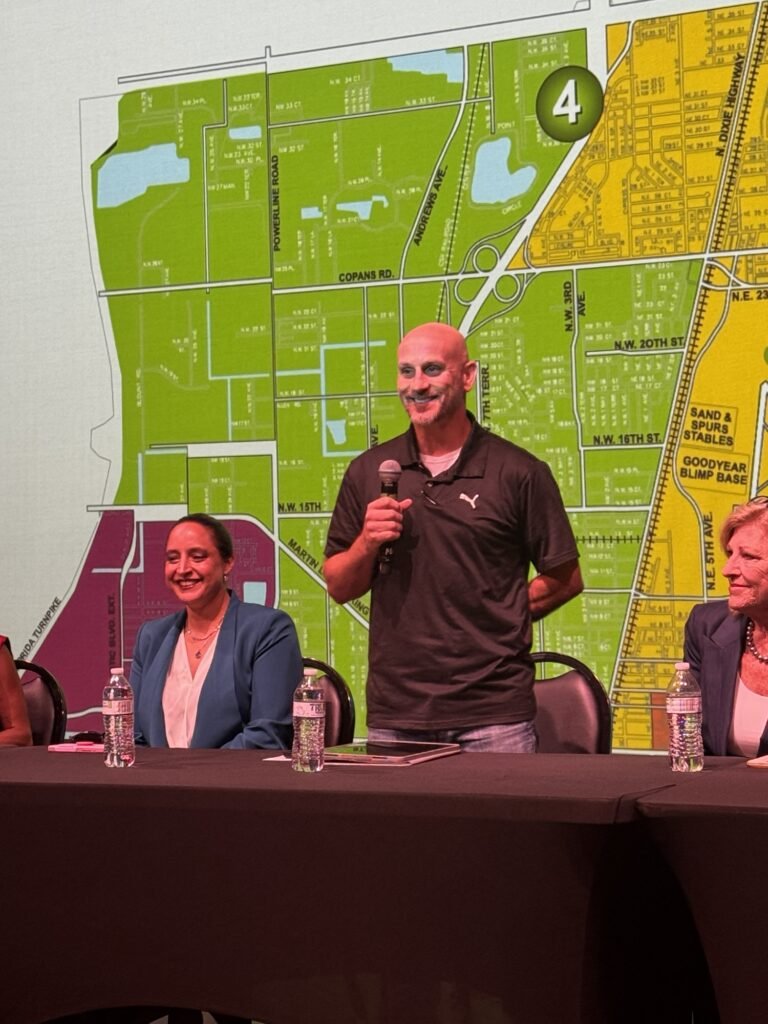
“If the city wants to encourage development, that’s one thing,” York said. “But if the city artificially inflates development and creates artificial markets, it’s just going to run our residents out of the city.”
York argued that rising property values and taxes are putting pressure on residents.
“We’re attracting new businesses and we’re attracting new visitors, but we’re not attracting new residents,” he said. “The residents are moving.”
His remarks reflected a more skeptical approach toward government intervention in development and a focus on the financial pressure growth can place on people already living in the district.
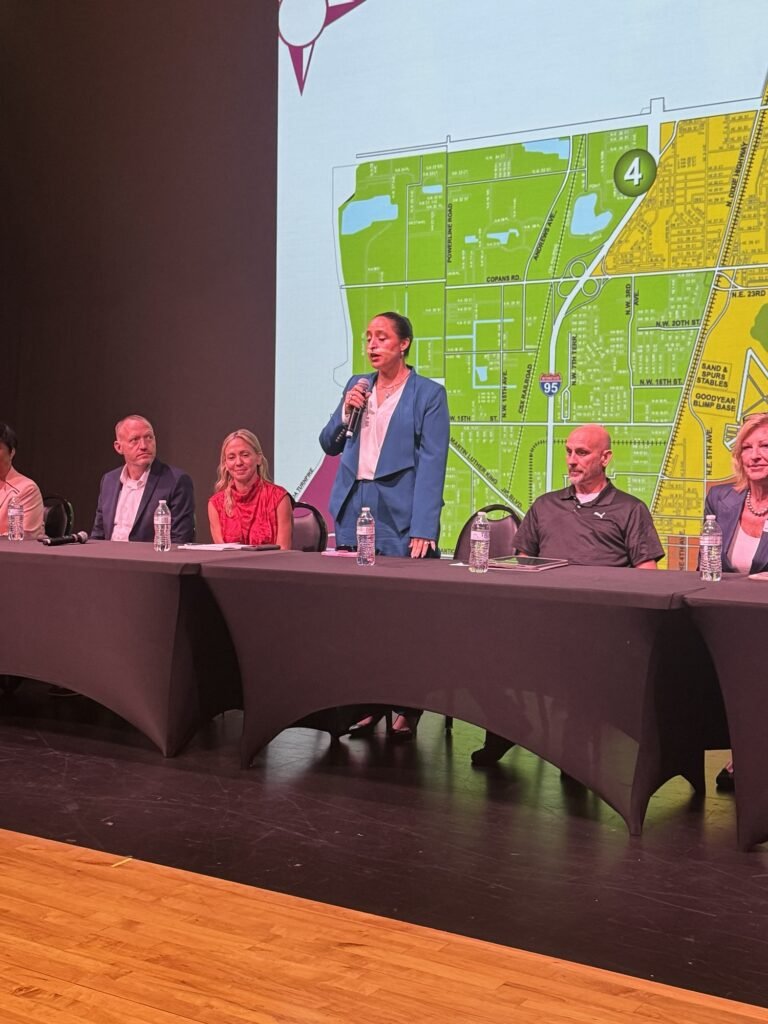
Brandi Zabadal, president of the Pompano Beach Highlands Civic Improvement Association, approached the issue from another direction: geographic representation.
Zabadal, who grew up in the Pompano Beach Highlands area and described herself as part of a working-class community, said residents away from the beach often feel disconnected from major city decisions.
“The people within my community — I don’t know if you knew this — we don’t live on the beach,” Zabadal said.
She argued that residents need better information and engagement from City Hall.
“For me, I think it would be smart if we then engaged our people,” she said. “We woke them up and we told them that this stuff mattered.”
Zabadal also argued that major development projects should create opportunities for local workers and businesses.
“We can buy into our community by asking them to be a part of this project and putting things out to bid,” she said.
And she called for a broader mix of development in District 2.
“I would love to see some beautiful things in District 2 besides warehouses and high-rise apartments — maybe some nice restaurants,” she said.
Her forum remarks emphasized neighborhood engagement, working-class residents, local contracting opportunities and spreading investment beyond Pompano’s beach corridor.
District 3: Fournier Says Growth Requires Balance
Vice Mayor Alison Fournier, who represents District 3 and is seeking reelection, described the city’s challenge in one word: “balance.”
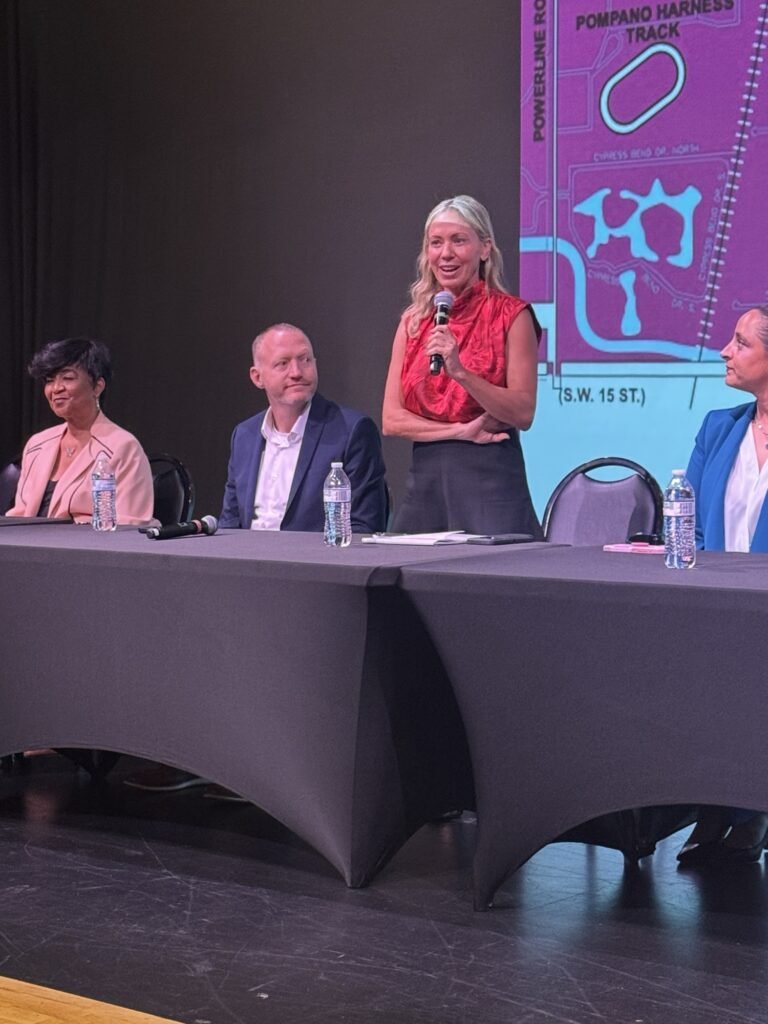
“Growth is coming,” Fournier said. “Growth is huge, and not just in Pompano Beach, but in all of South Florida.”
Fournier said residents are concerned that Pompano could lose the character that distinguishes it from neighboring communities.
“We still have a local feel that some cities in South Florida have lost,” she said.
Her approach emphasized maintaining quality of life while scrutinizing major development decisions and the use of public redevelopment dollars.
“We need to do our best to make sure the local participation, local residents have a seat at the table,” Fournier said.
She also said residents have expressed opposition or concern about some large development proposals and believe they have not always been heard.
“It is our job to ensure they are heard,” she said.
Fournier’s forum remarks emphasized managed growth, resident participation, protecting neighborhood character and careful use of public money.
During the forum, Fournier also noted that incumbent commissioners were operating under Florida’s Sunshine Law and said she had been advised to avoid detailed discussion of matters that could come before the commission for a vote.
District 4: Development Draws Support — But Different Ideas About Who Benefits
The District 4 candidates generally agreed that Pompano Beach should continue developing. Their differences centered on community participation and how the economic benefits should reach residents.
Commissioner Beverly Perkins, who has served on the commission since 2016, said she supports the city’s continued growth, including downtown redevelopment, but believes surrounding communities must be more involved.
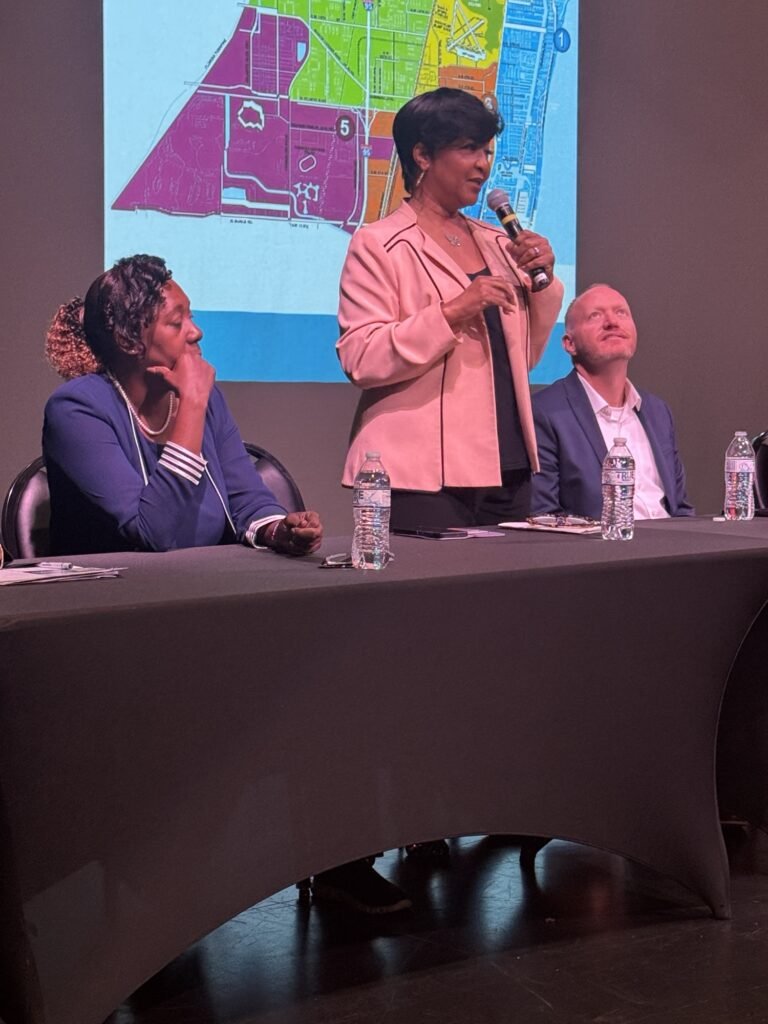
“I support it,” Perkins said of the downtown project. “But I do have two issues with the project.”
She did not detail those concerns during this portion of the forum, but argued that residents living around major projects and their district commissioner should be closely involved.
“When you bring a project into the City of Pompano Beach like a new downtown, the surrounding community of that project needs to be involved in the project,” Perkins said.
She described community involvement as a prerequisite for successful redevelopment.
“When we involve everybody in the project and not just a few people, it’s more successful on all levels,” Perkins said.
Her remarks emphasized continued economic development coupled with greater participation by people living in affected neighborhoods.
Former Florida state Rep. Patricia Hawkins-Williams emphasized collaboration and her experience working across different levels of government.
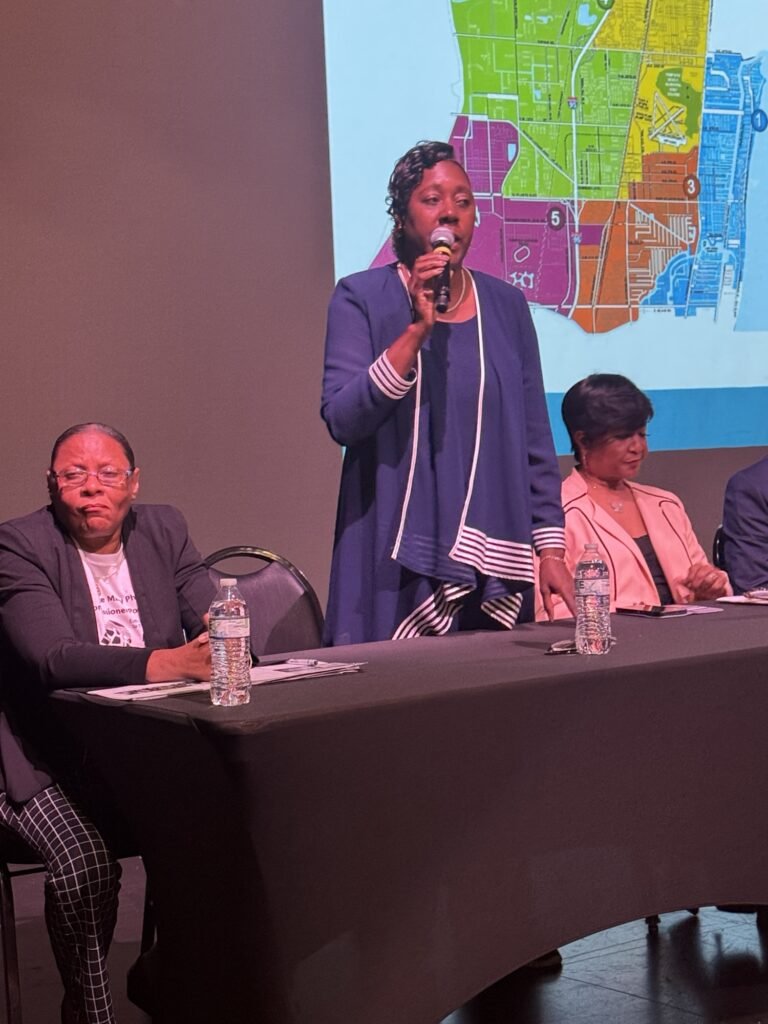
Hawkins-Williams, who previously served as a Lauderdale Lakes commissioner and in the Florida House, said redevelopment discussions should include residents, businesses, clergy and other community stakeholders.
“In order for everybody to be included, everyone needs to have a seat at the table,” Hawkins-Williams said.
She said development plans should be widely publicized and residents should have meaningful opportunities to participate.
“We need to all have the opportunity to bring forth ideas,” she said.
Hawkins-Williams framed her broader candidacy around her government experience and ability to work with people who disagree.
She said Pompano needs leadership capable of working with people who “do not think like me, look like me,” while still moving forward for residents and businesses.
The third District 4 candidate, Mary Phillips, focused heavily on small businesses, nonprofits, housing and directing more resources into neighborhoods.

Phillips, a real estate broker who said she owns two businesses and a nonprofit, argued that development remains necessary because an expanded tax base helps finance city services.
“Development is important for our community because it helps to bring tax dollars into our community,” Phillips said.
But Phillips said she wants development that creates jobs and “gives back to the community.”
She repeatedly emphasized nonprofits as potential partners in addressing local problems, including homelessness and youth development.
“We’ve got to help our nonprofits,” Phillips said. “We’ve got to help our for-profits, and we’ve got to help people survive.”
Phillips also connected redevelopment to affordability, pointing to housing costs and interest rates and drawing on her experience in real estate.
Her remarks emphasized economic development tied to jobs, support for nonprofits and small businesses, housing resources and making city assistance easier for residents to find.
Beyond the Question of Growth
The candidates’ answers demonstrated that Pompano Beach’s political debate is no longer simply about whether the city should grow.
The questions are increasingly about how fast it should grow, where investment should occur, whether infrastructure is keeping pace, how residents influence major projects, whether working-class residents can continue to afford the city and whether neighborhoods outside the beach and major redevelopment corridors are sharing in Pompano’s economic momentum.
The candidates often used similar language — particularly the repeated promise of giving residents a “seat at the table” — while describing different approaches to governing.
Fesik described commissioners as a check on development and emphasized resident interests. Worley emphasized growth accompanied by safety, infrastructure and adherence to city plans.
Sigerson-Eaton defended planned redevelopment and expansion of the tax base. York questioned whether government-supported growth is contributing to residents being priced out. Zabadal argued that communities such as Pompano Beach Highlands need greater attention and direct access to opportunities created by development.
Fournier called for balancing South Florida’s continued growth against Pompano’s existing character and residents’ quality of life.
In District 4, Perkins emphasized neighborhood involvement in projects; Hawkins-Williams stressed broad participation and collaboration; and Phillips focused on connecting economic development to nonprofits, businesses, jobs and household affordability.
Those differences give voters a more specific question than whether they support “growth.”
They will be deciding which approach they want representing their district during the next two years.
Pompano Beach’s municipal election is Tuesday, Nov. 3, 2026. Commission seats for Districts 1 through 5 are scheduled for election.
Discover more from Villij News
Subscribe to get the latest posts sent to your email.